

Nov 10, 2026. What our nervous systems have to do with populism, leadership, human connection and the possibility of systemic change.
What if polarization is not merely a battle of competing ideas, but also a battle for our nervous systems?
In a recent conversation with Joel Monk on the Coaches Rising Podcast, I explored a connection that has increasingly shaped my thinking about communication, leadership and societal transformation: the relationship between the language we use, the states of our nervous systems, and the quality of the spaces we create between one another.
The conversation, titled How Polarization Hijacks the Nervous System, starts with a the observation that our nervous systems are constantly scanning our environment for cues of safety and threat. And they do so long before our conscious minds have had a chance to evaluate what is happening.
This has profound implications for how we communicate - and for how we understand the current climate of political polarization.
The hidden physiology of polarization
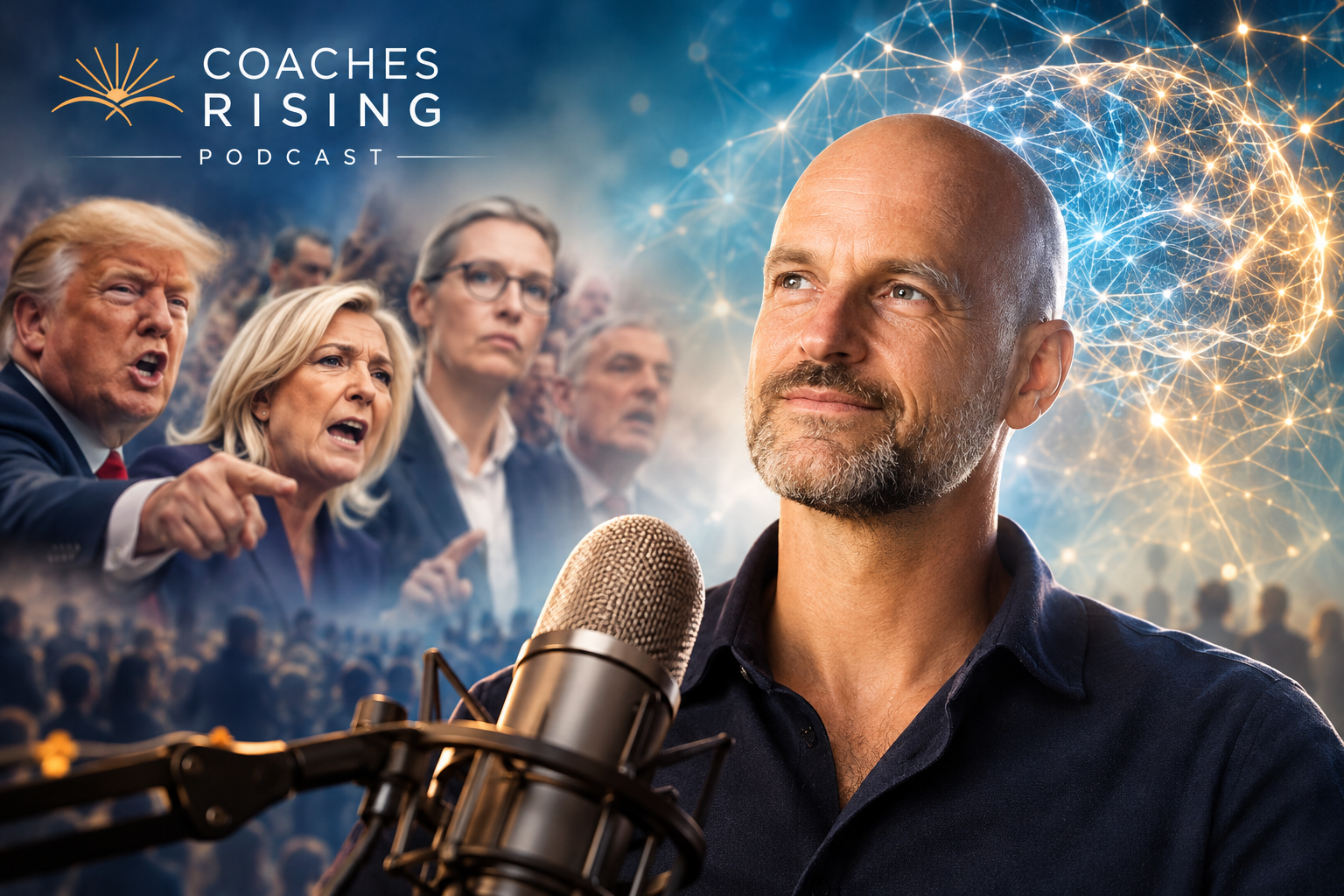
Think about the language often used in populist communication. People are described as a flood threatening to overwhelm a country. Societies are portrayed as being under siege. Particular groups become existential threats that must be defended against.
These are not neutral descriptions. Metaphors shape how we perceive reality. They activate emotional associations and can trigger physiological responses that make us feel threatened, even when we are simply reading a headline or scrolling through social media.
In the conversation, I draw on Stephen Porges' concept of neuroception: the nervous system's largely unconscious process of detecting cues of safety and danger.
When communication consistently evokes fear, anger and threat, we can become caught in a state of heightened arousal. Our attention narrows, our thinking becomes more binary, and our capacity to remain curious, empathic and open to complexity diminishes.
Polarization, in this sense, is not only something that happens between different groups. It also happens within us.
Transformation begins with regulation, not persuasion

Nervous system Regulation bridging divides. Illustration by ChatGPT.
What does this mean for coaches, leaders and anyone seeking to facilitate change?
One important implication is that we cannot always engage people through better arguments alone. When someone is dysregulated, their capacity to reflect, explore alternative perspectives and engage constructively may be significantly reduced.
In coaching, this means that creating a sense of safety and supporting nervous system regulation can be an important precursor to deeper developmental work.
I share an experience from my own practice with Somatic Experiencing that brought this home to me. Despite my intention to be fully present and supportive as a coach, my client sensed that I was still carrying some activation in my own nervous system. She asked me to move my chair further away - and then further still.
It was a powerful (and at the time for me slightly embarrassing) reminder: our physiological states communicate, often independently of what we intend to convey through our words.
Co-regulation works in both directions. We influence one another continuously, through our presence, our bodies, our language and the atmosphere we create together.
Tribalism as co-regulation around a common enemy
There is another, more uncomfortable dimension to this: If people are looking for safety and belonging, one way to create a sense of connection is to unite around a common enemy. Shared fear and outrage can produce a powerful form of collective belonging.
I describe this in the conversation as tribalism as co-regulation around a villain.
But what if we could create a different kind of belonging? One that does not depend on having someone to oppose, but emerges from the quality of our relationships, our capacity to listen and our willingness to stay present with difference?
This requires a different kind of inner capacity: the ability to hold tensions and apparent contradictions without immediately resolving them by choosing one side and projecting the other onto an enemy.
In a world increasingly organised around binary positions, the capacity to embrace a both-and perspective may be one of the most important leadership qualities of our time.
From individual healing to systemic transformation
Systemic influences and individual transformation - understanding neuroception & co-regulation. Illustration by ChatGPT
Joel and I also explore an important question: Are we placing too much responsibility on individuals to regulate themselves and heal, while ignoring the dysfunctional systems and environments they return to?
I believe we need to move beyond this either-or framing.
Individual and systemic transformation are intimately connected. Our inner states influence how we participate in relationships, teams and institutions. At the same time, the systems we inhabit shape our nervous systems, behaviours and possibilities for change.
We need both: inner work and collective action, personal responsibility and systemic change, local initiatives and broader societal transformation.
So for me the question is not simply how we change the world, but also how we show up in the spaces where change becomes possible.
What makes us human in the age of AI?
Towards the end of the conversation, we explore another fascinating dimension: what distinguishes human intelligence and connection from artificial intelligence?
AI can generate remarkably sophisticated language, simulate empathy and engage in apparently meaningful conversations. Yet there is a fundamental distinction between generating language about human experience and actually inhabiting that experience.
Our bodies and nervous systems carry an evolutionary history stretching back billions of years. Our relationships are embodied, reciprocal and consequential. We are affected by one another in ways that go beyond the exchange of information.
I argue that much of what makes communication meaningful does not reside in the words themselves, nor exclusively in the speaker or listener. It emerges between us.
This relational space - what we might call in-betweenness - is where meaning, connection and new possibilities emerge.
A different kind of change
Perhaps the most hopeful insight from our conversation is that transformation does not necessarily begin with a grand political movement, a new ideology or a revolutionary intervention. It can begin with something much closer at hand: the quality of our presence, the way we listen, the emotional states we bring into a room, and the spaces we create for others.
So not just different messages, but different physiological states; not just better arguments, but more capacity for connection.
In times of increasing fragmentation, this may be one of the most important contributions we can make - as coaches, leaders and human beings.
Listen to the full conversation:
How Polarization Hijacks the Nervous System — Christopher Kabakis on the Coaches Rising Podcast
A big thank you to Joel Monk for the thoughtful questions and the depth of this conversation. To be continued :-)!
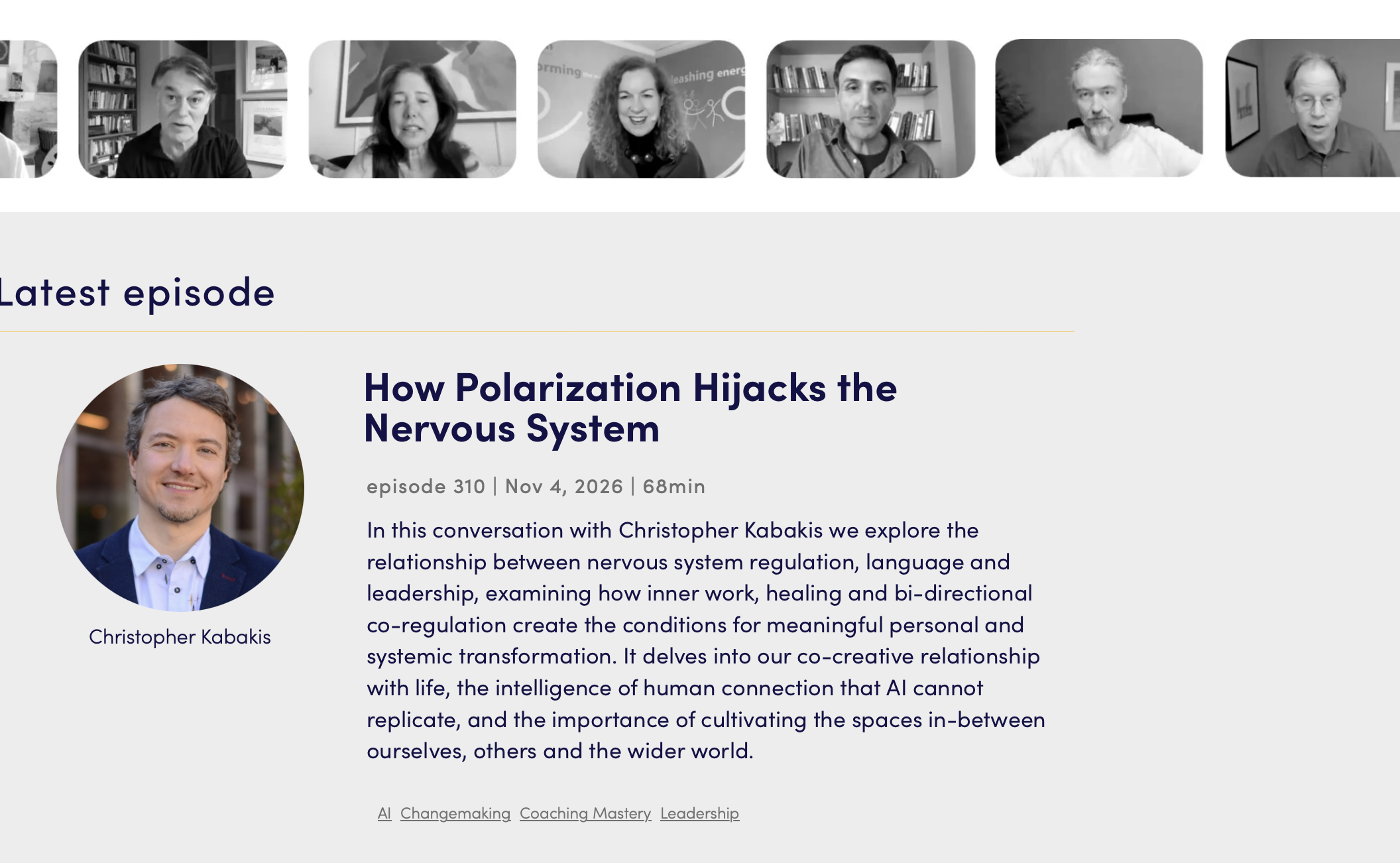
Coaches Rising Episode 310: How Polarisation Hijacks the Nervous System, Nov 4, 2026.